
Sometimes an artwork finds its name long after it has been made.
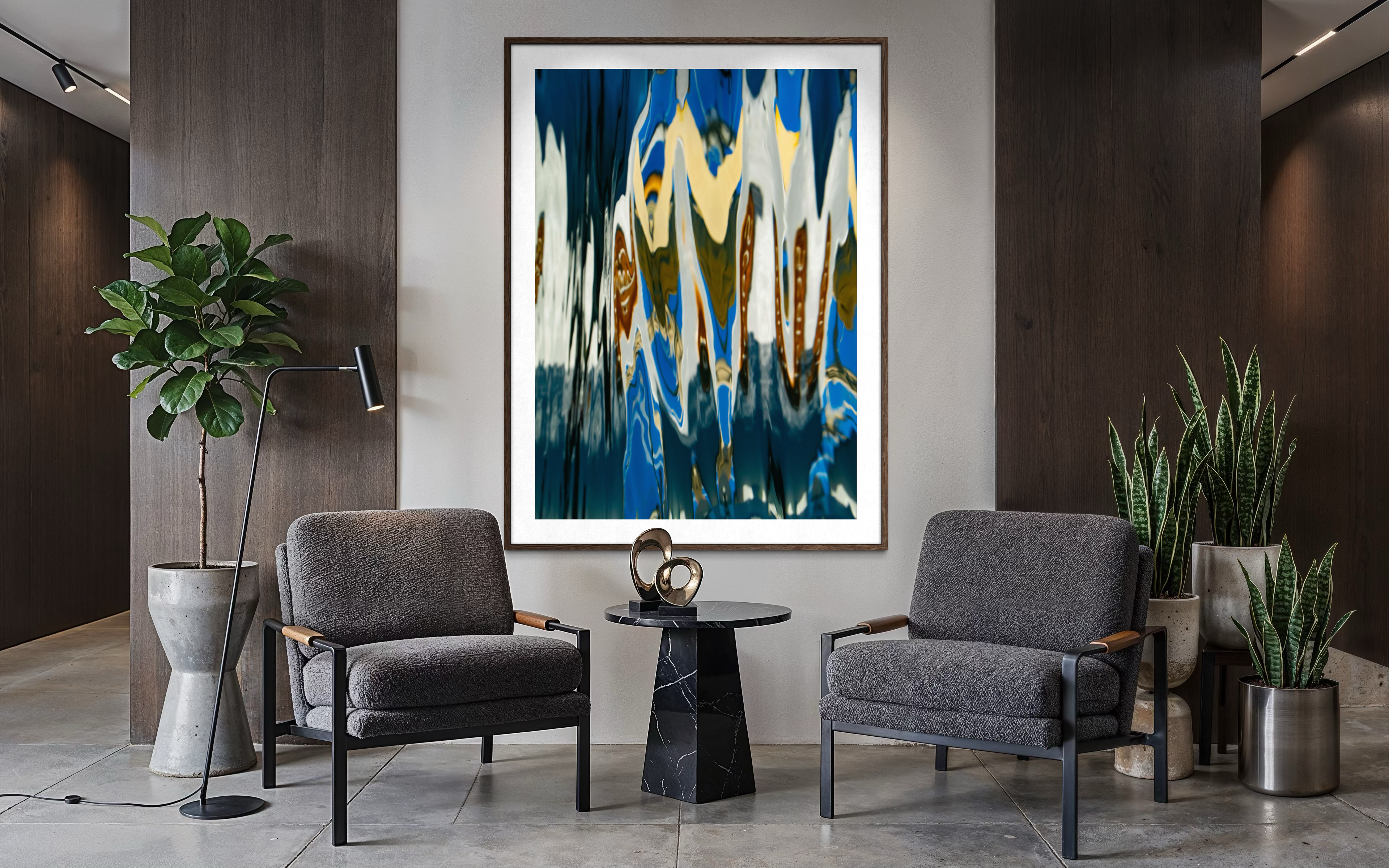
Kandinsky’s Follies began simply enough: a close-up artwork created from a reflection on the surface of the water, made from my kayak. The colours came from a vessel, but the water had taken possession of them. Blue, yellow, white, black and gold had been stretched and twisted into fluid forms that seemed to dance across the surface.
I knew there was something in the image, but for some time I couldn't find its name.
I kept seeing dancing figures. There was something theatrical about them — almost like a water follies — and my thoughts wandered towards the extravagant choreography of Busby Berkeley, where individual bodies become part of a larger moving pattern.
Those associations also led me to Berkeley’s great aquatic spectacle “By a Waterfall” in Footlight Parade (1933), where swimmers form shifting geometric patterns seen from above — a cinematic expression of the water-revue tradition of the 1920s and 1930s.
Then, quite serendipitously, I came across news of a Kandinsky work associated with his Improvisations. I knew Kandinsky, of course, but I had never really explored this extraordinary series of paintings.
Created principally between 1909 and 1914, Kandinsky's Improvisations were part of his revolutionary movement away from representing the visible world and towards expressing an internal one. Kandinsky borrowed the idea of improvisation from music. Rather than describing objects conventionally, colour, line, rhythm and form could operate more like musical elements — carrying emotion and creating their own internal movement.
Looking at the Improvisations, I suddenly recognised something.

Not that my artwork looked like a Kandinsky painting in any literal sense. What struck me was the underlying movement of the forms: colour seemingly liberated from the objects that originally produced it, shapes appearing and disappearing, and the feeling that the composition was dancing rather than sitting still.
That was what I had been seeing in my own photograph.
And suddenly the title arrived: Kandinsky’s Follies.
There is another connection that particularly appeals to me — improvisation itself.
Improvisation has always been fundamental to the way I work. I don't set out on the water knowing what artwork I am going to make. There is no constructed scene and no predetermined composition. I get into my kayak and paddle.
I search.
The improvisation is between myself, the kayak, the camera, the light, the wind and the constantly moving surface of the water. A reflection may exist for only a fraction of a second before the water reorganises it into something completely different.
That is the excitement.
Kandinsky’s Follies is, in physical terms, simply the reflection of a vessel captured very close to the surface of the water. Yet the camera has captured something that I could never have designed: elongated figures, ribbons of colour and forms seemingly caught mid-dance.
The vessel supplied the colour.
The water created the choreography.
And, many months later, Kandinsky helped me understand what I had found.


