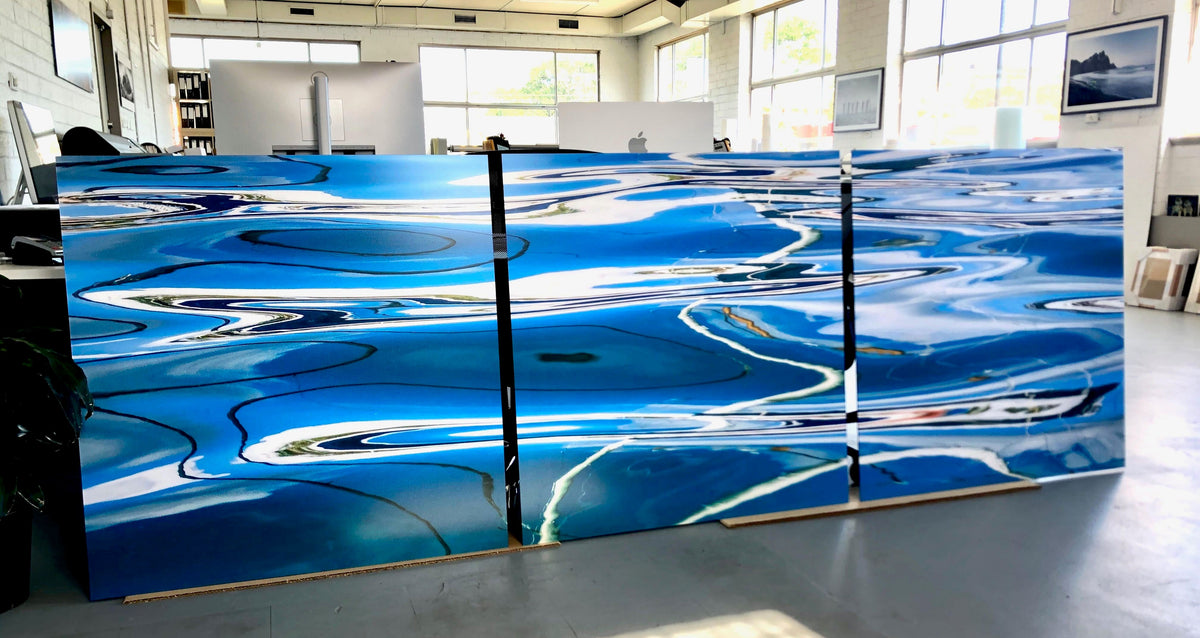

The wall that deserves more than a filler
Every interior has one wall that does the work of the whole room. It's the one clients stand in front of at the walkthrough, the one that shows up in every photograph of the finished space. And it's the one that most large-scale wall art guides get wrong, because they treat it as a sizing problem: measure the sofa, take two-thirds, order accordingly.
Sizing matters. But if you've ever sourced for that wall under deadline, you know the harder problem isn't the tape measure. It's finding a piece with enough presence and story to hold a room that size, without disappearing into it or feeling like it was chosen for the wall rather than for itself.
That's the brief I hear most often from designers and serious buyers: a serious artwork for a home, apartment, office or interior project, something with presence, atmosphere and a quiet story behind it, not another generic decor filler.
What 'large scale' actually needs to deliver
 Emerging Warmth - Louis Vuitton Commission
Scale amplifies whatever is already in the image. A generic pattern blown up to fill a wall just becomes a bigger generic pattern. But an image with depth, real light, real movement, a moment that was actually witnessed rather than built in a studio, gets more interesting the larger it goes. Detail you wouldn't see at postcard size becomes the thing you notice on your third look, and your thirtieth.
That's the test worth applying before anything else: does this image reward a longer look? Large-scale wall art lives on a wall for years. If there's nothing left to discover after the first week, the size becomes a liability rather than an asset, a big, quiet admission that the piece was chosen to fill space rather than to hold it.
My own work is built around that test. The abstract pieces in my collection come from reflections, colour and movement on the surface of the water, captured, not staged, mostly paddled from my kayak on Sydney Harbour and on waters further afield. They are not constructed scenes. They are discoveries. At large scale, that distinction becomes visible in the work itself: the eye keeps finding new movement in the water because the movement was real to begin with.
Skip the custom-commission timeline

For designers, the standard path to a large-format statement piece is a custom commission: briefing an artist, waiting on studio time, reviewing proofs, waiting again for production and framing. It's a reasonable process for a client who has months to spare. It is not reasonable when the install date is fixed and the wall is empty.
The alternative worth building into your sourcing process is a limited edition that already exists, already realised at large format, that can be specified into a project on the timeline the project actually has. Works like Burning Outback and Invisible Eyes exist precisely for that wall. My works run from about 95 cm to 220 cm on the long side, delivery anywhere in Australia is 14 days from approval, and if the wall calls for a particular size, any work can be commissioned to suit it.
Story carries the scale

A large piece with no story behind it reads as decoration, however well it's sized. A large piece with a story behind it reads as art, and clients, guests and colleagues respond to that difference even when they can't articulate why.
Every image in my collection has a specific place and moment attached to it: a particular stretch of water, a particular light, a particular morning. That's not a marketing detail added afterward. It's the actual origin of the work, and it's why the pieces hold up as the centrepiece of a room rather than a backdrop to it. For projects where the story needs to do real work, a boutique hotel, a client-facing office, that documented provenance becomes part of the brief you can hand back to the client, not just the artwork itself.
Where scale meets calm
There's a reason water imagery in particular tends to work at large format in ways busier subjects don't: the surface of water is meditative by nature, and a large-scale piece built from it can make an entire room feel more settled rather than more cluttered. That's especially true in spaces where people spend long hours, offices, waiting areas, busy receptions, where a large abstract water piece can act as a therapeutic anchor rather than competing visual noise. If you're specifying for a workspace, this is worth reading alongside biophilic office art and why water imagery calms high-traffic workspaces.
A practical shortlist for sourcing large-scale wall art
When you're evaluating a piece for a serious wall, a few questions cut through most of the noise:
- Does it hold up close and far back? Large scale should reward both the across-the-room view and the up-close one.
- Is it a limited edition or an open run? A limited edition carries weight that an open-ended print run doesn't, so ask directly how the edition is structured.
- Is there a real story attached, or a generic title? A documented origin gives you something to say to the client, and something for them to say to their guests.
- Can it be delivered on your timeline, and is framing handled, or does the schedule depend on a commission process you haven't budgeted for?
- Does the artist have a body of work and exhibition history, or is this a one-off print with no context behind it?
Seeing it in the room before you commit
The question clients ask most at this stage is whether the piece will suit the wall. In Sydney, Newcastle and Wollongong, I'm glad to visit the space and look at it with you; elsewhere I provide a digital mockup showing the work in the room. Framing isn't included by default: I consult on it and provide it when the client asks for it.
Starting the search without the sales conversation
You don't need to commit to a piece to start narrowing the field. I've put together a free eBook, Journeys on Water, as an introduction to the collection and the story behind it, a way to look through the work at your own pace before any conversation about a specific project or wall. It's an invitation to look closer, not a hard sell. And if you want the fuller story of how the images are made, read abstract water photography explained.
FAQ
Where can I buy very large wall art without a lengthy custom process?
Limited editions that already exist are the fastest reliable route. Rather than commissioning a new work from scratch, look for pieces already produced at large format by an established artist, so the timeline is delivery and install rather than months of studio production.
What is the 2/3 rule for wall art?
The general guideline is that a piece (or grouping) should cover roughly two-thirds of the width of the furniture or wall space it sits above or beside, so it reads as intentional rather than undersized. It's a useful starting point for scale, but it's worth pairing with a piece that has enough depth and story to reward a long look, not just the right footprint.
Does the work come framed?
Not by default. I consult on framing for each project and provide it when the client asks for it.
Is large-format limited-edition work one-of-a-kind, or is it print-on-demand?
A limited edition is produced in a fixed, finite run and is not reprinted indefinitely; that's the core difference from mass-produced or print-on-demand decor. My works are signed giclée prints on museum-quality archival paper in editions of 3, 5 or 10, and the edition number is shown on every listing. Alternatively, other materials such as canvas and prints on metal have been used to suit a client's tastes.
If this is of interest, visit the Ralph Kerle's Art Commission web site for more information


