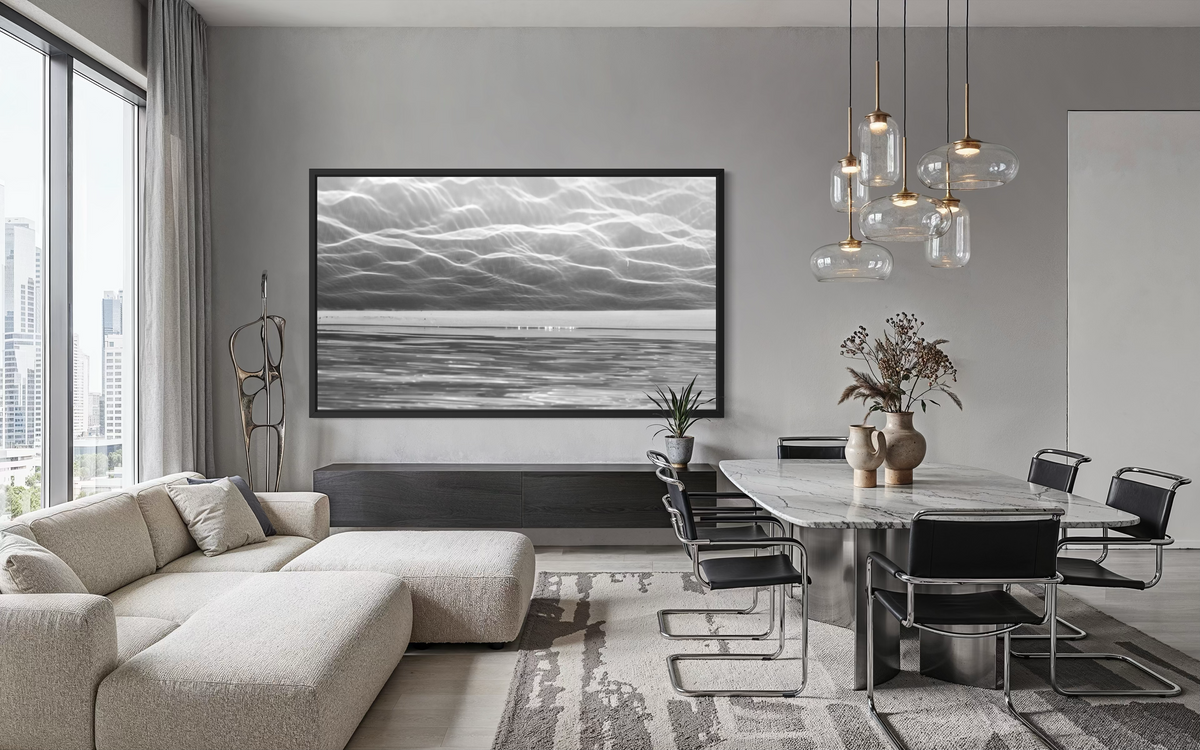
There are occasions when I am on the water when what I see seems almost impossible to translate into an artwork.
City of Light began with one of those moments.

I was paddling on Middle Harbour near Mosman Rowing Club in Sydney when I passed a vessel moored nearby. Its hull was white with an unusual silver finish. Sunlight struck the surface of the vessel while wind disturbed the water beneath it, breaking the reflected light into colour, movement and fragments.
What appeared in the water was extraordinary.
For a moment I was no longer looking at the reflection of a boat. In my imagination I was looking into a city.
It seemed like the exterior of a dense and vibrant downtown district: buildings, windows, streets, movement and activity compressed together. When I later examined the artwork on my computer, I discovered something I hadn't fully registered from the kayak. Scattered throughout the water were tiny points of brilliant light. They looked like lights coming on across an imagined metropolis.
That was when the title arrived: City of Light.
The phrase has a long history. Paris became known as the City of Light initially through its association with the Enlightenment and the illumination of ideas, and later through the artificial lighting that transformed the modern city.
My City of Light is different.
There is no city here.
There are no buildings, streets or electric lights. What appears urban has been created entirely by the interaction of natural forces and physical surfaces.
This brings me to an idea that is increasingly important in my work: Nature's Technology.
We usually think of technology as something humans invent. But when I am working on the water, I am constantly observing another kind of technology operating around me. Light. Wind. Water. Stone. Reflective surfaces. Movement. These elements combine and recombine continuously, creating visual structures that exist for only an instant before disappearing.
In City of Light, nature's technology seems to have constructed its own metropolis.
There is another difficulty with this artwork, and I think it is important to acknowledge it.
I am taking a risk in releasing it.

The colour and luminosity I experienced on the water are extremely difficult to reproduce on a digital screen. A screen can show the composition, but I am not convinced it can communicate the physical vibrancy of the work as I saw it.
For that reason, I want City of Light to exist primarily as a ChromaLuxe Clear Gloss metallic artwork. Using dye sublimation, the image is transferred through heat and pressure into the coated aluminium surface rather than simply sitting on top of it. The clear gloss finish allows the underlying silver of the metal to become part of the visual experience.
For this particular artwork, that matters.
The vessel that created the original reflection was itself white and silver. By returning the artwork to a reflective metallic surface, I am attempting to bring something of that luminosity back into the finished piece.
Before I finally judge City of Light, I want to see it physically produced. I want to stand in front of it, allow light in the room to interact with its surface and discover whether the artwork can recover what I remember seeing from my kayak.
Perhaps that uncertainty is part of the work.
The original City of Light existed for only a moment on Middle Harbour. Wind, sunlight, water and a silver vessel assembled it, I witnessed it, and then it disappeared.
What remains is my attempt to bring that moment back into the physical world.


