 The moment I noticed what water does to a room
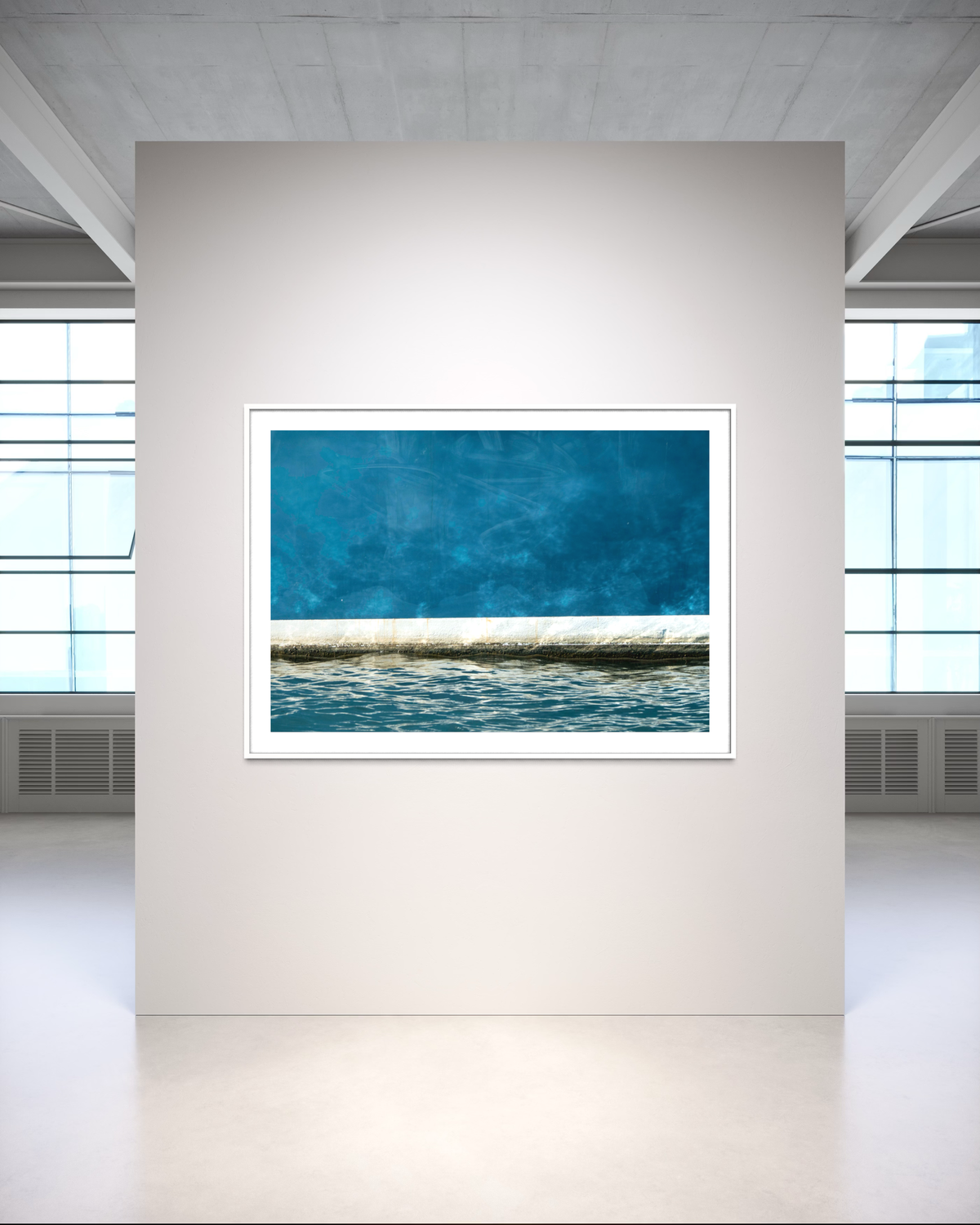
I paddled out onto Sydney Harbour before the wind picked up, the way I do most mornings, camera close at hand. The light was still low and soft, catching the surface in that particular way it does for maybe twenty minutes before the day flattens it out. I wasn't thinking about offices or lobbies or fit-outs. I was thinking about the water itself — the way it folded colour into itself, the way a reflection could hold still and move at the same time.
It was only later, standing in front of the printed work, that I understood what I'd actually found. People stopped in front of it. They went quiet. Something in the image slowed them down, the same way the harbour had slowed me down that morning. That reaction is not something I designed. I simply discovered it, the way I discover every image — paddling, watching, capturing what the surface of the water was already doing.
Why water imagery is having a moment in office design
Biophilic design — bringing natural elements into built environments — has moved from wellness buzzword to standard specification brief. The underlying idea, sometimes traced back to psychologist Erich Fromm's concept of biophilia and later developed by E.O. Wilson, is that people are innately drawn to nature, and that built environments which ignore this draw tend to leave people more stressed and less able to concentrate (freeofficefinder.com).
Water is consistently named as one of the core environmental features designers reach for, alongside plants, natural light, wood and stone (coel.co.uk). As Katie Oldknow, Head of Design at COEL, puts it: biophilic design is about "reconnecting people with nature. Creating a calmer, creative, considered healthy workspace, all whilst supporting people to be more engaged and thus productive" (coel.co.uk). Ruscha Fields of The Good Plant Company makes a similar point about artwork specifically: "a painting depicting nature" can give people the same sense of proximity to nature as a wooden floor or a view of trees (coel.co.uk).
The broader research base for biophilic design in workplaces points to real gains in wellbeing — sustainability consultancy Terrapin Bright Green states that "biophilic design can reduce stress, enhance creativity and clarity of thought, improve our wellbeing and expedite healing" (coel.co.uk), and Oliver Heath, Director of Oliver Heath Design, frames it as a way to reduce stress and improve recuperation across a built environment (ninfastudio.com). None of this is about a decorating trend. It's about giving people in high-traffic, high-pressure workspaces something to rest their attention on.
Where most biophilic office art falls short

The trouble is that a lot of what gets specified under the banner of biophilic design is generic. A leafy print here, a mass-produced water motif there — imagery chosen for colour palette rather than for what it actually is. For a trade designer, that's a real problem: clients considering a serious artwork for a home, apartment, office or interior project are asking for presence, atmosphere and a quiet story behind the piece — not wallpaper with a nature theme.
This is where real, unstaged water photography earns its place on a high-traffic wall. My work isn't built in a studio or composed digitally. It comes from actual mornings on actual water — mostly Sydney Harbour, sometimes further afield — captured on a digital camera and brought out in Adobe Lightroom, never constructed as a scene. They are not staged compositions. They are discoveries. That distinction matters in a boardroom or a reception the same way it matters in a gallery: the person looking at it, whether they know it or not, is looking at something that actually happened on the surface of the water, not something rendered to resemble it.
Reading a reflection: what calms the eye in a busy space
There's a reason reflection and movement on water read as meditative rather than chaotic, even in an abstract frame. The eye follows a natural, unforced pattern — nothing is symmetrical in the way a grid or a corporate logo is symmetrical, but nothing is jarring either. It's the same organic irregularity that biophilic design principles point to when they talk about natural shapes and forms calming the brain more effectively than sharp, rigid geometry.
In a high-traffic workspace — a reception desk, a boardroom wall, a corridor people pass a hundred times a day — that matters more than in a quiet study. The eye needs somewhere to land that doesn't demand anything of it. A photograph of water folding light into itself gives people exactly that: a therapeutic pause between meetings, not another thing to process. For designers sourcing large-scale wall art for a room clients will never stop looking at, that quality of quiet, ongoing interest is the whole brief.
Provenance over palette: what a documented artist story adds to a spec

Abstract prints bought purely on colour match rarely survive a client asking the obvious question: what am I actually looking at? A trade designer fielding that question needs more than a title and a frame size. Limited-edition water photography carries an answer built in — where the water was, what the light was doing, and why the image was never staged to begin with. That's the difference between abstract water photography with a documented discovery behind it, and a print with no provenance at all.
For designers building out a considered collection across a project, that story-rich grounding also makes each piece easier to place with confidence as a limited-edition work worth collecting, rather than a decorative placeholder that will need replacing once the trend moves on.
Specifying without the wait: ready-to-place limited editions
Trade designers rarely have the runway for a lengthy custom commission when a client has already committed to a fit-out timeline. Limited-edition works that are already captured, printed and ready to ship remove that bottleneck — the image exists, the provenance exists, and the only decision left is scale and placement on the wall in question. That's a meaningfully different proposition to briefing an artist from scratch and hoping the result matches the mood board.
It's the same principle that applies when sourcing art advisors are asked to find statement pieces for clients: the strongest option is usually the one that's already real, already documented, and simply waiting for the right wall.
An invitation, not a brief to fill blindly
None of this is a hard sell, and it was never meant to be. Choosing a piece of water photography for a high-traffic office wall is closer to what happened to me that first morning on the harbour — a quiet, personal recognition that something on the surface of the water was worth stopping for. My free 'Journeys on Water' eBook exists for exactly that reason: to let a trade designer or their client sit with the images and the story behind them before any conversation about a wall, a size, or a project even begins.
FAQ
Is biophilic office art the same as a plant wall or greenery?
No. Biophilic design covers a range of natural elements — plants, natural light, wood, stone and water among them. Water imagery, including photography of reflections and movement on the surface of water, is recognised as one of the core environmental features designers use alongside greenery, not a substitute for it.
Why choose real water photography over an abstract print for an office?
A print chosen purely for palette has no story behind it. Real, unstaged photography of water — captured on location rather than constructed as a scene — gives a piece documented provenance, which matters when a client or visitor asks what they're actually looking at.
Can limited-edition art be specified quickly for a project with a tight timeline?
Yes. Ready-to-ship limited-edition works remove the wait associated with a custom commission, since the image, the printing and the provenance already exist — the remaining decision is simply scale and placement.
Does biophilic art actually reduce stress in workspaces?
Research cited by designers and consultancies working in this space links biophilic design generally to reduced stress and improved wellbeing, though results vary by environment and study. It's best understood as one part of a broader biophilic design approach rather than a guaranteed outcome from any single piece.


