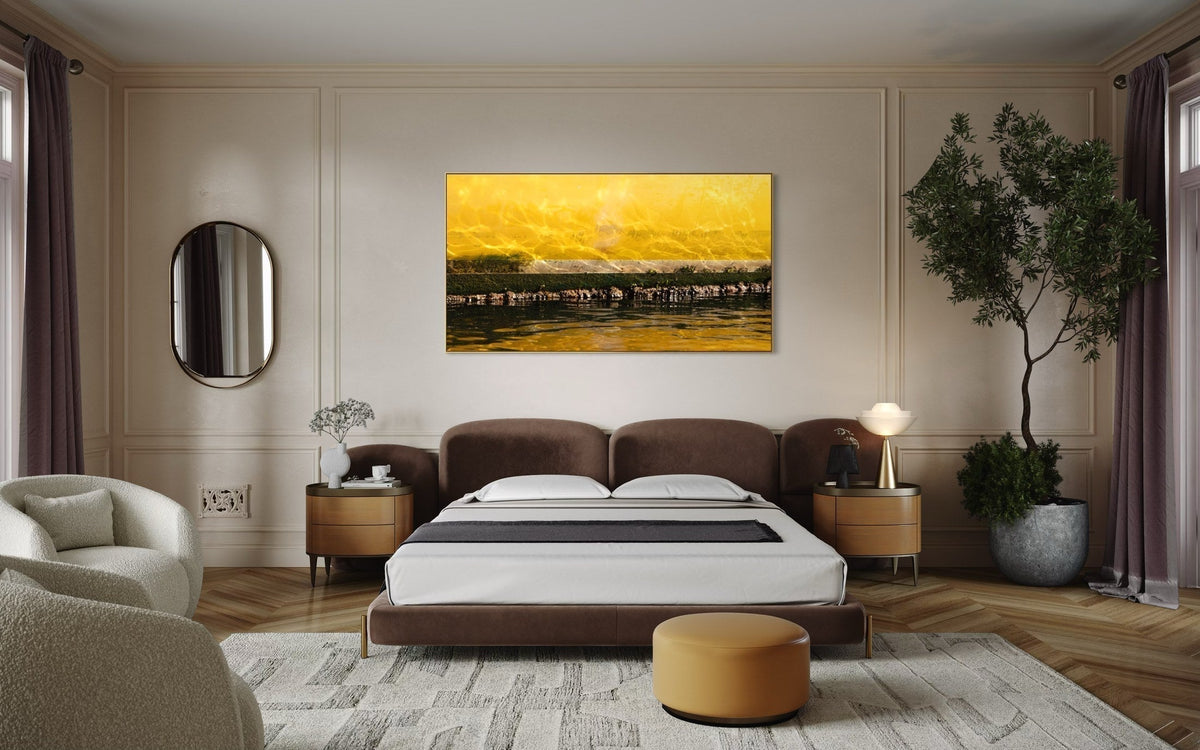
The Impressions of a Turner Landscape Collection grew from my longstanding fascination with the English painter J. M. W. Turner.
Turner worked from the late eighteenth century into the middle of the nineteenth century, yet much of his work feels strikingly modern. His forms often dissolve into light, colour and atmosphere. In my estimation, he was one of the first modern Impressionist painters—and, at times, his work appears to move even further towards abstraction.

Many of Turner's works were shaped by water: the sea, rivers, storms, mist and the shifting light of the sky. My own practice is also based on water, with its reflections, movements and fleeting illusions created across the surface. Colours and structures of vessels can lose their original identities. Light fractures their forms. Reflections stretch, compress and dissolve. For a moment, the surface of the water can appear to open onto another place entirely.
When I encountered Turner’s work for the first time, I instantly felt that connection in his work. Slave Ship (Slavers Throwing Overboard the Dead and Dying, Typhoon Coming On), 1840 is an excellent example.
The more I viewed his work, the more it offered me the opportunity to develop a collection of imagined landscapes—artworks that might initially appear to depict distant horizons, mountains, shorelines or changing weather, but which are formed through light, water and reflection.

Impressions of a Turner Landscape 9 continues this exploration. Its luminous yellow field and darker horizontal forms create the suggestion of a landscape, but the artwork never settles into a single interpretation.
That uncertainty is one of the aspects of the collection that most interests me.
When I ask people to describe what they see in these artworks, they almost invariably describe a landscape. Yet each person's landscape is different. One viewer may see a distant shoreline; another may find mountains, mist, desert or light breaking across water.
I experience the same uncertainty myself. I return to these artworks regularly and continue to discover forms and relationships that I had not noticed before.
This is central to my thinking behind the LandEscape Collection: an escape into a landscape created partly by water and light, and partly by the viewer's imagination. The works offers the initial illusion, but their final meaning belongs to the person looking at it.


