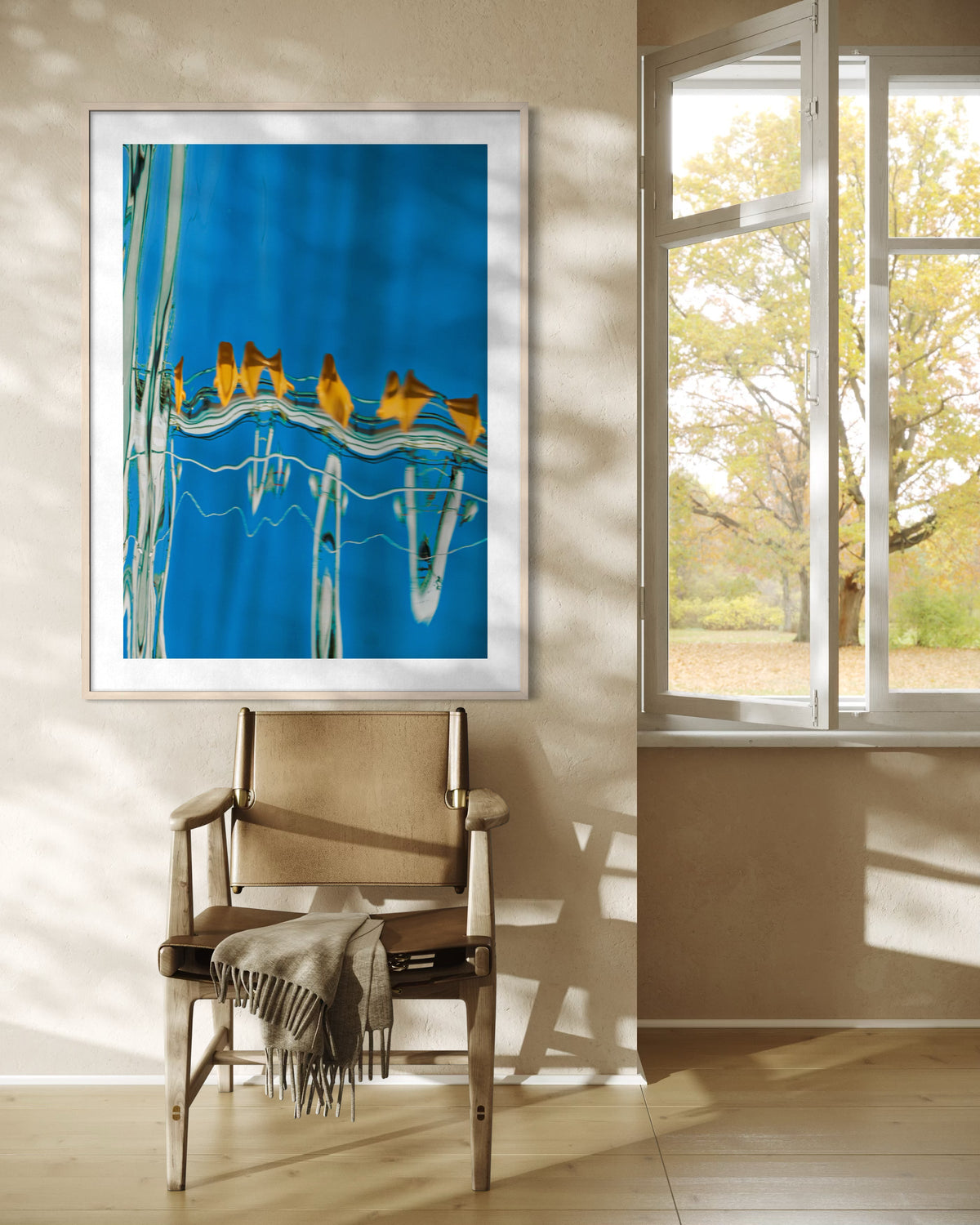
Nature is a rather accomplished magician. She needs no top hat, no velvet curtain and certainly no assistant. All she requires is light, water and someone prepared to look a little longer.
I have spent years watching reflections unfold on the surface of water. They are never quite still, and they rarely behave as we expect. A familiar object can lose its identity in an instant. Lines bend, colours drift, and something recognisable becomes something wonderfully strange.
That transformation has always interested me more than identifying what I’m looking at. Once we name an object, we tend to stop seeing it. We have solved the puzzle. But a reflection can persuade us to remain in that delightful moment before recognition, when the imagination is free to play.
The Water Ballet began with a simple change of viewpoint.
When I return from the water and review my work, I sometimes rotate an image on the screen. I’ll turn it upside down or consider what the scene might look like from a completely different position. This can reveal the origin of a reflection, but every so often it does precisely the opposite: it creates an entirely new illusion.
This time, partway through turning the image, I stopped.

There, suspended against an extraordinary blue, were golden shapes that seemed to be dancing. Beneath them, slender ribbons of white and green undulated like a tightrope or the edge of a theatrical stage. I could almost imagine the performers waiting for their cue, each with a slightly different movement or personality.
It was one of those rare and delicious little epiphanies. I had not set out to make a ballet. Yet suddenly I was looking at a performance.
A magician’s greatest skill is not simply to hide something. It is to direct our attention so convincingly that we see one thing while another remains in plain sight. Nature does this all the time. She rearranges appearances without changing the underlying reality. The illusion is not a lie; it is another possible way of seeing.
The surprise also reminds me that looking is never passive. Even before we understand an image, we are sorting rhythm, colour and shape, arranging fragments into stories of our own.
And we, the viewers, are not innocent bystanders. We complete the trick. One person might see dancers. Another might see acrobats, a procession, or an improbable cast balancing above an electric-blue stage. Our memories and imaginations enter the picture, supplying movement and meaning.
I rather like that no two people need to see exactly the same thing. It makes the artwork a collaboration between nature, the artist and the viewer.

I could tell you what originally gave rise to these reflections. But that would be like inviting the magician to reveal the hidden mechanism before the audience has enjoyed the illusion. Where would be the pleasure in that?
For now, I prefer to leave the curtain half drawn, the performers poised and the mystery intact.
Welcome to The Water Ballet.
Act One.


