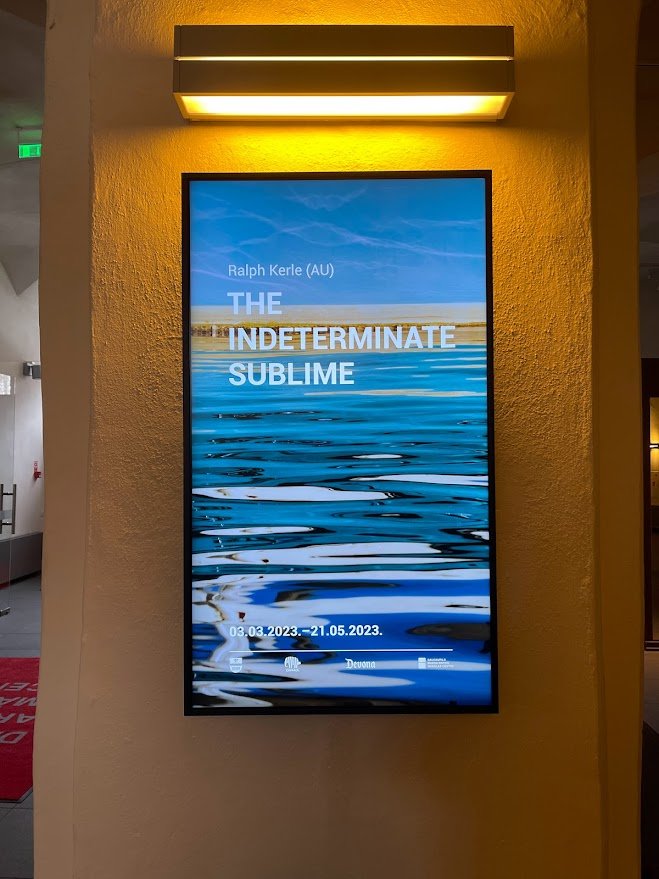
A video of the official opening of the exhibition including a speech by the Australian Ambassador to Sweden Finland and Latvia and a short speech in which I describe the history and intent behind the exhibition and the artworks.

A video of the official opening of the exhibition including a speech by the Australian Ambassador to Sweden Finland and Latvia and a short speech in which I describe the history and intent behind the exhibition and the artworks.
Kandinsee, 2026. Reflected water, altered blue tones, and modernist influence converge in a single image [/caption] There's a moment in every work when I sense whether it's ready to speak. This one wasn't — not at first. When I looked at the original photograph, the shapes I always look for were already there. A vertical figure rising from the water. A scatter of cut-out forms drifting on the surface. The interplay of something solid against something liquid. The bones of the work were present. But the blue stopped me. Usually my prefrontal cortex — that strange fountain of accumulated experience, of decades of galleries and books and remembered light — moves immediately. A title appears. An influence whispers itself. The work declares its lineage before I've finished blinking. This time, it stayed quiet. The blue in the water surface was too heavy, too settled. It stultified the cortex. It refused to lift. It refused to let the work become what I could feel it almost was. [caption id="" align="alignnone" width="5472"] The original photograph, before Lightroom. The shapes are already there — the vertical figure, the cut-out forms, the wires turning to liquid — but the blue refuses to lift. The cortex stays quiet. [/caption] So, for the first time, I made a change. I opened Adobe Lightroom and reached for the colour picker. I asked the software to mask what it called "the sky." The algorithm was lying — there was no sky in this photograph, only the surface of the water reflecting back. But I let the machine have its small mistake, and I lightened the blue. Gently. Then more. Until the background lifted. [caption id="" align="alignnone" width="3840"] Kandinsee — after a single deliberate edit. The blue lightened just enough for Kandinsky, Matisse and Dalí to arrive. [/caption] And then, finally, the work spoke. I saw Kandinsky — his vertical instinct, his belief that yellow and blue carry weight, his sense that a single line can hold a whole composition's tension. Yellow Blue Vertical, whispered through reflected water. I saw Matisse — the cut-out shapes drifting at the surface, simplified, sure of themselves, refusing the fuss of detail. And I saw Dalí — the hard objects of the everyday world rendered soft and pliable, melted by the water's slow breath. Wires, a chair, a figure, all turned to liquid memory. Hard and soft, holding hands. What surprises me is that none of this was painted. None of it was staged. It was already there, waiting in nature — in a few inches of moving water, on a day I happened to look down. For the first time, I admit it: I lifted one colour. I made one change. And in doing so, I let three modern masters arrive — already living, quietly, in the surface of a pond.
Learn moreWater moves, Light welcomes colour and dances, A presence asks to be seen. Ralph Kerle 2026 [/caption] It began, as it often does for me, on the water. I was kayaking on Sydney Harbour in extraordinary conditions—one of those April days where everything felt as if it had resolved itself into something complete. The air was clear, the water moving just enough to remain alive, and my body had settled into that familiar rhythm of stroke and glide. It was as if I had finally discovered it was nature that had created paradise. There is a point, out there, when something shifts. The mind stops organising the world and begins receiving it. It is not quite thinking, and not quite observation. It feels closer to meditation—though even that doesn’t fully describe it. A kind of openness arrives, and with it, something I can only call a heightened attentiveness. Not dramatic. Not mystical. But a clear sense that something is present—and asking to be noticed. It was in that state—still moving, still on the water—that the question first appeared. Not as a conclusion, but as a quiet insistence. What is it that happens in these moments? Why does something unexpected suddenly feel meaningful? And what is the force that makes me stay with it? A red hull drifted into view, its reflection slipping and reforming beneath it. For a moment, I found myself less interested in the object than in what it was becoming in the water—stable above, unstable below. Present, and yet constantly dissolving. And it was there, in that subtle shift of attention, that three ideas began to take shape. Serendipity. Curiosity. Ikigai. They did not arrive as definitions, but as recognitions—something I had been living without ever naming. And as I remained with them, still drifting, still watching, I felt the need to hold onto the thought before it disappeared back into the vault of the unconscious. So I began a different kind of conversation when I returned to the studio. Not with another person, but with a form of intelligence that does not experience the world as I do. It does not feel the water, or the air, or the quiet unfolding of that moment. And yet, it is capable of reflecting those experiences back to me in language—not unlike a film script being read for the first time. What follows is not a solitary essay, but a shaped exchange—between lived experience and expression, between perception and reflection. [caption id="" align="alignnone" width="2420"] Emerging Warmth [/caption] Serendipity: The Shock of Arrival To be in a serendipitous state is to feel something arrive before you understand it. There is a subtle interruption—a break in expectation. The world presents something that feels slightly out of place, yet deeply right. Time loosens. Attention sharpens. You are no longer moving through the moment; the moment is, in some sense, moving toward you. This is how it happens for me on the water. I do not set out to find a particular image. I am not searching in any conventional sense. And yet, from time to time, something presents itself with a clarity that feels undeniable. A reflection aligns. A form emerges. And in that instant, there is recognition before comprehension. Serendipity is not chance alone. It is the meeting point between what is offered—and what is noticed. [caption id="" align="alignnone" width="3835"] On the Way to Bluedom [/caption] Curiosity: The Pull of the Unfinished But the moment does not end there. What follows is curiosity—the quiet insistence that there is more here than I have yet seen. Curiosity does not rush. It lingers. It asks me to stay with the image, to shift position, to look again. What first appeared as a fleeting alignment begins to unfold into something more complex, more ambiguous, more alive. There is, within curiosity, a tension. To look closely is to risk seeing something unstable—something that shifts as we stay with it. The longer the gaze, the less certain the image becomes. This is true of the reflections I work with. They resist resolution. They refuse to settle into a single meaning. And it is precisely this instability that holds me there. Curiosity is not satisfied by answers; it is sustained by the possibility of seeing differently. In this way, the role of water begins to change. It is no longer simply a surface that reflects, but something that participates. Something that moves, distorts, reveals, and conceals all at once. What I am engaging with is not just an image. It is a relationship. [caption id="" align="alignnone" width="3470"] The Redness in Reflection [/caption] Ikigai: The State That Remains Over time, something begins to form. Not a single moment, but continuity between moments. Not a question, but a way of seeing that quietly repeats itself. Out there on the water, there are times when everything aligns without effort. The movements of the kayak, the rhythm of looking, the appearance of an image, the act of capturing it—they are no longer separate actions. They feel like part of the same flow. There is no sense of trying to make something happen. And yet, something is happening. It is not dramatic. It does not announce itself. It is simply… right. This, I think, is the closest I come to understanding the Japanese concept of Ikigai, often described as “a reason to wake up in the morning”—but out here, it feels less like something defined, and more like something recognised. A state I enter—again and again—when I remain open to what is in front of me, and attentive enough to follow it. The water has taught me this more than anything else. It never holds a single form, yet it is always itself. It shifts, adapts, reflects, and dissolves, without ever needing to decide what it is. And somewhere in that movement, I recognise something familiar. Not that I am observing the water—but that I am thinking with it. In this sense, Ikigai is not something separate from the world. It is a relationship to it. [caption id="" align="alignnone" width="2974"] Water Percussion [/caption] A Reflection on Intelligence What has surprised me most in writing this is not the ideas themselves, but the way they have taken shape. This essay has emerged through a dialogue. On one side, there is lived experience—embodied, sensory, immediate. The physical effort of paddling. The shifting surface of the water. The moment of recognition that arrives without warning. On the other, there is a form of intelligence that does not experience any of these things. It does not see, or feel, or inhabit the world. And yet, it is capable of reflecting those experiences back in language—organising them, extending them, giving them structure. In a way, this process mirrors the very phenomenon I have been describing. I encounter something in the world. It is reflected back to me in another form. And in that reflection, I begin to understand it more clearly. The relationship between perception and articulation becomes a kind of loop—one that deepens rather than resolves. If there is a single insight that has emerged from this reflection, it is this: Meaning is not something we impose on the world. It is something we enter into relationship with. Serendipity offers the moment. Curiosity asks us to remain. And over time, those moments begin to shape a life. A life that feels less like something we have planned— and more like something we have discovered. And sometimes, in the quiet balance of the water, something else is present— something that doesn’t belong to thought or perception at all. As Japanese haiku master, Matsuo Bashō understood, this meaning does not sit apart from the world—it appears in the act of noticing it. Ralph Kerle © April 2026 This essay was developed through a dialogue between lived experience and a form of reflective intelligence.
Learn moreWater Map 1 110 × 180cm “I think about the country where I was walking and camping, all the main water holes, all the camping areas… and I follow them up with my painting.”— Freddie Timms, East Kimberley artist When I first looked at Water Map 1, I did not immediately see water. I saw sand. I saw an aerial field. I saw something that appeared to have been remembered rather than photographed. This new work belongs to both my Offshore Aerial Collection and my Sand Talk Collection, and perhaps that is why it captured my creative focus in such a compelling way. It began, as usual, as a photograph of reflections on the surface of water. Yet the final image seemed to have travelled somewhere else. It no longer behaved only as water. It appeared as terrain, as if a moving surface had opened into a map. What struck me first was the space in the work. The simplicity of the central form. The way the surrounding field holds it quietly, without crowding it. The centre of the image feels spare, but not empty. It has weight. It has presence. It sits inside the work like a place. Almost immediately, I thought of the great East Kimberley painters: Paddy Bedford, Freddie Timms, Rover Thomas, Queenie McKenzie, Shirley Purdie, and the Warmun/Turkey Creek artists whose work transformed Australian painting. Their paintings can appear deceptively simple at first glance: large areas of ochre, strong forms, restrained composition, vast spaces. Yet within that apparent simplicity is country, memory, movement, ceremony, history and story. I do not pretend to fully understand the emergence of Kimberley painting, but I have long been moved by the way it carries a view of land that seems both grounded and aerial. Freddie Timms’ paintings are often discussed as aerial maps of the Country he knew through walking, camping, mustering and living. His statement about remembering waterholes, camping areas and places of work speaks directly to the way painting can become a form of following — not inventing a place, but returning through memory to where one has been. Shirley Purdie offers another statement that stopped me because of its connection to photography. She has said: “When you paint you can remember that Country, just like to take a photo, but there’s the Ngarranggarni (Dreaming) and everything.” That phrase — just like to take a photo — is extraordinary. It makes a bridge between image, memory and Country, while also making clear that the image is not merely visual record. It holds story, spirit, inherited knowledge and lived experience. Examples of Kimberley art from Freddie Timms, Shirley Purdie and Rover Thomas (l-r) When I looked at Water Map 1, I felt an unexpected connection to those statements. Not as a claim to Indigenous knowledge, and not as an attempt to make Indigenous art. Rather, I felt a recognition in the idea that an image can become more than the thing it first appears to depict. My photograph began as water. Yet it appeared as sand. It was taken through close observation, yet it felt as though it had been seen from above. It was a reflection, yet it opened into something like terrain. In that moment, the artwork seemed to sit between surface and depth, between looking down and looking over, between water below me and an aerial perception above me. In the late 1990s, I was fortunate to spend time working on a cultural project connected to Indigenous ritual and creative practice. Being on Country and being exposed to the visual languages of Central Desert painting began to shift my understanding of what painting could be. I started to understand, however modestly, that these works were not simply images of land. They were ways of holding land, knowing land, remembering land and seeing the world. What astonishes me still is that both Central Desert and East Kimberley painting often seem to contain an aerial perception long before the aerial image became part of ordinary visual culture. They appear to rise above the land while remaining profoundly inside it. That is the feeling that returned to me through Water Map 1. There is also, for me, a strange sense of ascent and descent in the work. I am looking down into water, yet the image seems to lift me upward into an aerial field. I am photographing a surface, yet the result feels as if it has emerged from beneath the surface. Water becomes sand. Reflection becomes map. Abstraction becomes a place of recognition. This is why Water Map 1 feels like a new threshold in the Sand Talk Collection, while also belonging naturally to the Offshore Aerial Collection. It is an offshore image that behaves like inland memory. It is water that seems to remember land. I am interested to know whether others sense this too. Do you see water, sand, aerial Country, or something in between? Does the work carry, for you, an echo of Kimberley painting — not in imitation, but in spaciousness, restraint and the feeling of a map seen from above? For me, Water Map 1 is not a map of water. It is a map made by water — and perhaps, more truthfully, a map made by looking long enough for water to become memory.
Learn moreYour cart is currently empty.