This Is Not a Ralph Kerle Artwork
This is not a Ralph Kerle artwork.
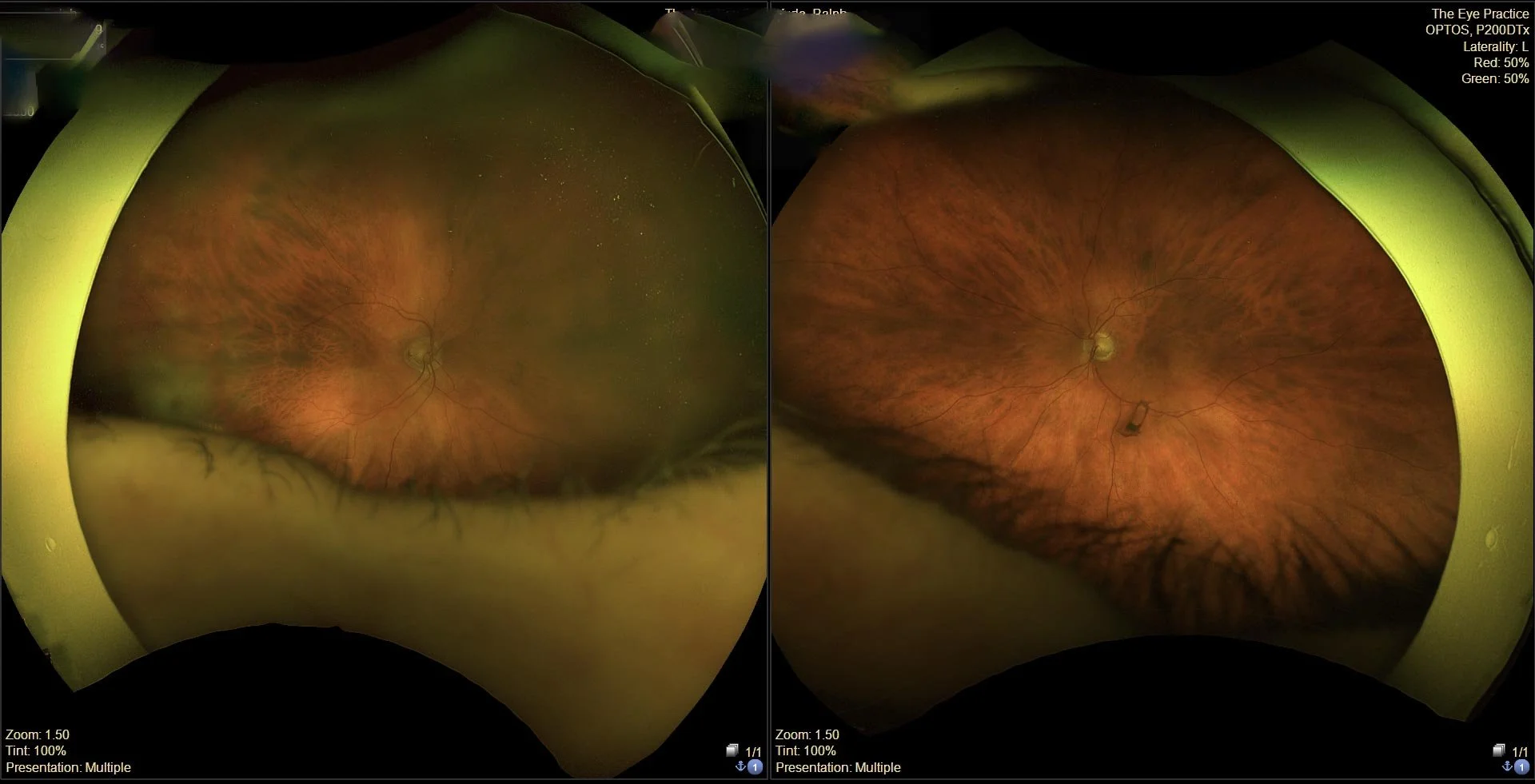
It is an image of the retinas at the back of my eyes, taken recently at The Eye Practice in Sydney by my regular optometrist, Dr Natasha Tein.
The image was made on an Optos ultra-widefield retinal imaging system, a technology developed to see more of the retina in a single view than traditional retinal photography allows. Optos itself grew out of a deeply human story: its founder, Douglas Anderson, began the company after his young son lost sight in one eye when a retinal detachment went undetected. The machine is therefore not simply a piece of clinical equipment. It is an instrument designed to look further into the eye, to reveal the peripheral and hidden edges of sight, and to turn what is usually invisible inside the body into an image that can be read, studied and, in my case, wondered at.
The image on the left is the back of my right eye, which has been looking through a 44-year-old corneal transplant. Part of it appears beautifully out of focus, as if the eye itself is still negotiating the terms of vision. The image on the right shows the retina of the eye that still carries keratoconus, a degenerative condition of the cornea, the surface through which light first enters the eye.
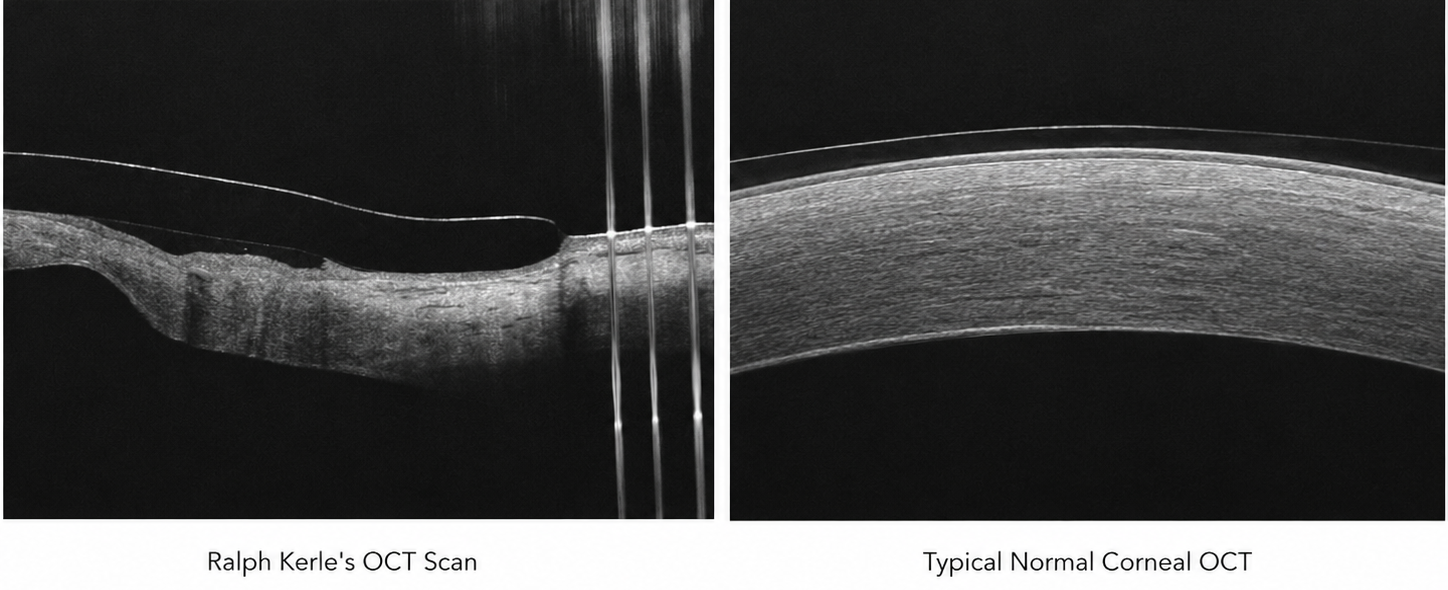
A second image, made through Optical Coherence Tomography, shows the eye in another way altogether. If the retinal image is a view into the interior field of seeing, this scan is more like a cross-section of the surface through which light must first pass. In the context of my eyesight, it reveals something of the physical terrain of the cornea — the delicate, uneven architecture shaped by keratoconus, surgery, age and adaptation. Readers are not looking here at what I see, but at part of the structure that affects how seeing begins. It is a landscape of tissue, a threshold image, the place where light first meets the body before the brain begins the mysterious work of turning it into vision.
So there it is: a private map of my seeing.
These delicate red vessels carry visual information to the brain. They are not art, but they are certainly image. They are not landscape, but they have atmosphere. They are not abstract photography, but they do have a strange resemblance to something I might have found floating on the skin of water.
Perhaps that is the joke.
I have spent years photographing reflections, distortions and unstable surfaces, only to discover that some of the instability was inside the instrument doing the looking.
But that is also the gift.
The eye receives light. The brain makes meaning. Art gives that meaning somewhere to live.
I am going to make this into an artwork I will own, because it reveals so much and yet so little about the way I see.