The Art Journal

The Blues in the Horizon - Just an ordinary day’s work for a kayaker artist.
An ordinary day on Middle Harbour leads me to wonder why blue can bring a horizon, a memory and a sense of calm so close.
Learn more
On Top of the Mountain
A climb up Mount Kosciuszko and a photograph made years earlier leave me wondering what the camera records and what the mind remembers.
Learn more
How to Choose Large-Scale Wall Art for a Room You'll Never Stop Looking At
Most large-scale wall art guides talk about sofa widths and colour palettes. This one is about finding the single piece a room is built around: sized right, ready to specify, and carrying a story worth telling.
Learn more
The Water Ballet: When Nature Becomes the Magician
What if nature were a magician and water her stage? A simple change of viewpoint revealed a company of golden performers dancing above a field of blue. In The Water Ballet, I explore the pleasure of seeing beyond the familiar — without giving away the trick.
Learn more
City of Light: When Nature Builds a Metropolis
On Sydney's Middle Harbour, sunlight, wind, water and the silver hull of a vessel momentarily created something unexpected: an imaginary city. City of Light introduces a new idea emerging in my work—Nature's Technology.
Learn more
Biophilic Office Art: Why Water Imagery Calms High-Traffic Workspaces
Real, unstaged Sydney Harbour water photography gives high-traffic offices genuine biophilic calm — with a story generic prints can't offer.
Learn more
A Landscape Within A Reflection - JMW Turner's Influence
In Impressions of a Turner Landscape 9, light, water and reflection create an imagined landscape whose meaning changes with every viewer.
Learn more
Treecolour: Beauty, Memory and the Australian Landscape
In a secluded mangrove channel of Sydney’s Middle Harbour, native trees dissolve into luminous greens, turquoise light and dark floating forms. Treecolour explores the tranquil beauty of this hidden waterway and the tension created by the industrial history that still shadows its landscape.
Learn more
Kandinsky’s Follies — Finding Music in the Water
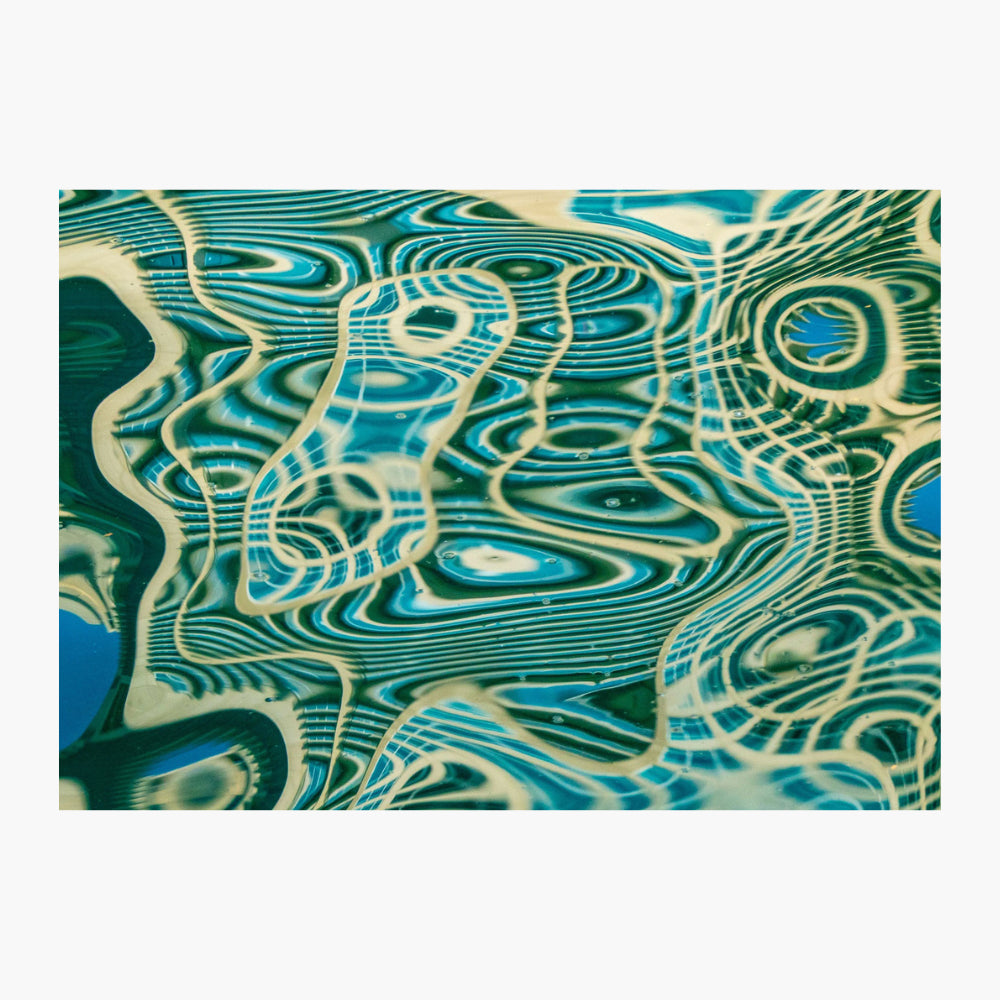
Kandinsky’s Follies began simply enough: a close-up photograph of a reflection on the surface of the water. The colours came from a vessel, but the water had taken possession of them. Blue, yellow, white, black and gold had been stretched and twisted into fluid forms that seemed to dance across the surface. I knew there was something in the image, but for some time I couldn't find its name.
Learn more
Blue Mood: Putting the Senses Back in Order
Can water change the quality of our attention? Introducing Blue Mood, a visual summary of connection, restoration, and those rare moments when our senses finally return to order.
Learn more
Light Consciousness - A Psychedelic Travellers Journey by Roger Foley Fogg
I am delighted to be quoted in Roger Foley’s wonderful new book, Light Consciousness - A Psychedelic Travellers Journey which charts his career as one of Australia’s leading lighting designers. Roger began designing rock concerts and psychedelic light shows in the 1960s. His experimental work—including his lumino-kinetic Light Sculpture—continued through the 1970s and anticipated many of today’s multimedia installations and immersive experiences. Roger asked me to contribute my thoughts on abstract art and its creation after reading an earlier reflection on abstraction in my Art Journal. His book is an extraordinary record of the beginnings of an art form that has now become widely recognised and fashionable: the multimedia experience. A PDF copy of Roger’s book can be downloaded below. [Download Roger Foley’s book]
Learn more
Kandinsee - Kandinsky, Matisse and Dalí in Reflected Water
Kandinsee, 2026. Reflected water, altered blue tones, and modernist influence converge in a single image There's a moment in every work when I sense whether it's ready to speak. This one wasn't — not at first. When I looked at the original photograph, the shapes I always look for were already there. A vertical figure rising from the water. A scatter of cut-out forms drifting on the surface. The interplay of something solid against something liquid. The bones of the work were present. But the blue stopped me. Usually my prefrontal cortex — that strange fountain of accumulated experience, of decades of galleries and books and remembered light — moves immediately. A title appears. An influence whispers itself. The work declares its lineage before I've finished blinking. This time, it stayed quiet. The blue in the water surface was too heavy, too settled. It stultified the cortex. It refused to lift. It refused to let the work become what I could feel it almost was. The original photograph, before Lightroom. The shapes are already there — the vertical figure, the cut-out forms, the wires turning to liquid — but the blue refuses to lift. The cortex stays quiet. So, for the first time, I made a change. I opened Adobe Lightroom and reached for the colour picker. I asked the software to mask what it called "the sky." The algorithm was lying — there was no sky in this photograph, only the surface of the water reflecting back. But I let the machine have its small mistake, and I lightened the blue. Gently. Then more. Until the background lifted. Kandinsee — after a single deliberate edit. The blue lightened just enough for Kandinsky, Matisse and Dalí to arrive. And then, finally, the work spoke. I saw Kandinsky — his vertical instinct, his belief that yellow and blue carry weight, his sense that a single line can hold a whole composition's tension. Yellow Blue Vertical, whispered through reflected water. I saw Matisse — the cut-out shapes drifting at the surface, simplified, sure of themselves, refusing the fuss of detail. And I saw Dalí — the hard objects of the everyday world rendered soft and pliable, melted by the water's slow breath. Wires, a chair, a figure, all turned to liquid memory. Hard and soft, holding hands. What surprises me is that none of this was painted. None of it was staged. It was already there, waiting in nature — in a few inches of moving water, on a day I happened to look down. For the first time, I admit it: I lifted one colour. I made one change. And in doing so, I let three modern masters arrive — already living, quietly, in the surface of a pond.
Learn more